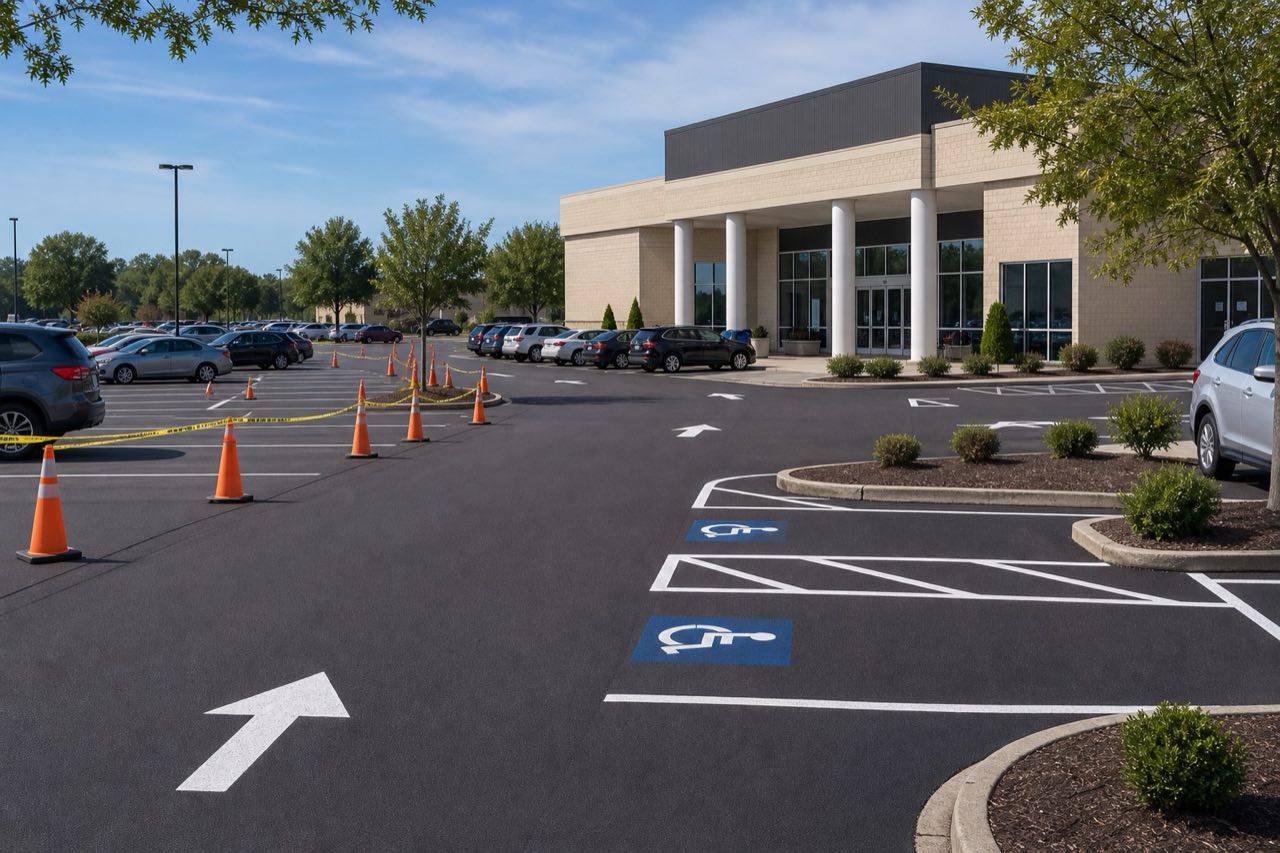
What should a striping plan identify?
Use a scaled or field-verified layout that identifies standard and compact stalls, accessible and van spaces, access aisles, signs, pedestrian paths, stop bars, arrows, fire lanes, loading zones, no-parking areas, curb markings, crosswalks, numbers, pickup zones, and any reserved or electric-vehicle spaces. Confirm who approves each symbol and color before mobilization.
A reconfiguration can change stall count, circulation, turning clearance, accessible routing, and delivery behavior. Test difficult corners and large-vehicle paths rather than maximizing stripe count on paper. For High Point showroom and Market traffic, temporary overflow or valet plans should not erase permanent accessible routes or create conflicting arrows when visitor volume rises.
How does striping fit after sealcoat?
Sealcoat must cure enough to accept paint without tracking, bleeding, or bond loss. The striping date therefore follows preparation, repairs, each sealer coat, and the product's recoat and cure window. If the lot opens before markings return, the traffic plan needs temporary controls and a short, defined interval—not an unmarked free-for-all.
Ask whether the paint is waterborne traffic paint or another specified system, how many coats or passes apply, what surface temperature and moisture limits govern, and when vehicles can cross it. Existing lines may need layout marks before coating so entrances, fire lanes, and accessible geometry are restored accurately rather than reconstructed from memory.
What does parking lot striping cost in July 2026?
Striping is commonly priced per stall, linear foot, symbol, arrow, curb foot, or mobilization. The fact pack did not establish a verified High Point price menu, so no local-looking rate is published. A simple repaint over visible lines differs from a new layout requiring measurement, chalking, removal or black-out, multiple colors, signs, and staged nighttime access.
Request an item count: standard stalls, accessible symbols, access aisles, arrows, stop bars, crosswalk lines, lettering, curb, fire lane, loading zones, and mobilizations. Separate layout verification and sign work. The vendor confirms the written total after the plan and field quantities are approved; an allowance can cover owner-directed changes without hiding the unit cost.
What should happen from estimate through reopening?
Before painting, the owner supplies or approves the layout and authorities responsible for fire or accessibility requirements are consulted when needed. The crew cleans the surface, masks or removes conflicting marks, measures and chalks the plan, applies the specified paint, sets cones, inspects edges and symbols, photographs the completed layout, and opens traffic after the stated cure.
Weather belongs in the work order. Many sealcoat products call for pavement and air temperatures of at least 50°F with temperatures staying above the minimum during cure, no rain for 24 hours or more, and warmer conditions for dependable drying. Crack and patch materials have their own rules. The vendor should confirm the named product, forecast threshold, postponement decision, and reopening time for the actual date.
What if the pavement reveals a different problem?
Faded lines can reflect normal wear, but peeling, tracking, bleeding, or rapid loss may point to dirty pavement, dampness, incompatible sealer, insufficient cure, low paint film, cold application, or early traffic. A wrong stall geometry is a layout failure, not a paint failure. Separate the cause before scheduling a duplicate repaint.
Changes should be explicit. The crew should photograph the condition, explain why it falls outside the agreed scope, state the added quantity or alternate treatment, and obtain authorization before proceeding. You may choose the revision, defer that zone, or request another opinion. A surprise beneath dirt is possible; a blank permission slip for unlimited added work is not necessary.
How should you compare written proposals?
Compare quantities, layout responsibility, line width, paint type and color, passes, surface preparation, removal or black-out, signs, wheel stops, phases, night work, traffic control, cure, photos, and exclusions. Require the owner-approved accessible plan rather than relying on a clause that says match existing when the old configuration has not been verified.
Confirm the actual provider before approval. North Carolina's general-contractor threshold under N.C.G.S. §87-1 is $40,000 for covered projects, so a typical residential sealing price does not prove or disprove qualification by itself. Property rules, scope, and other trades can create different requirements. Verify identity, insurance required by you or the property, references when available, payment terms, and responsibility for the proposed work.