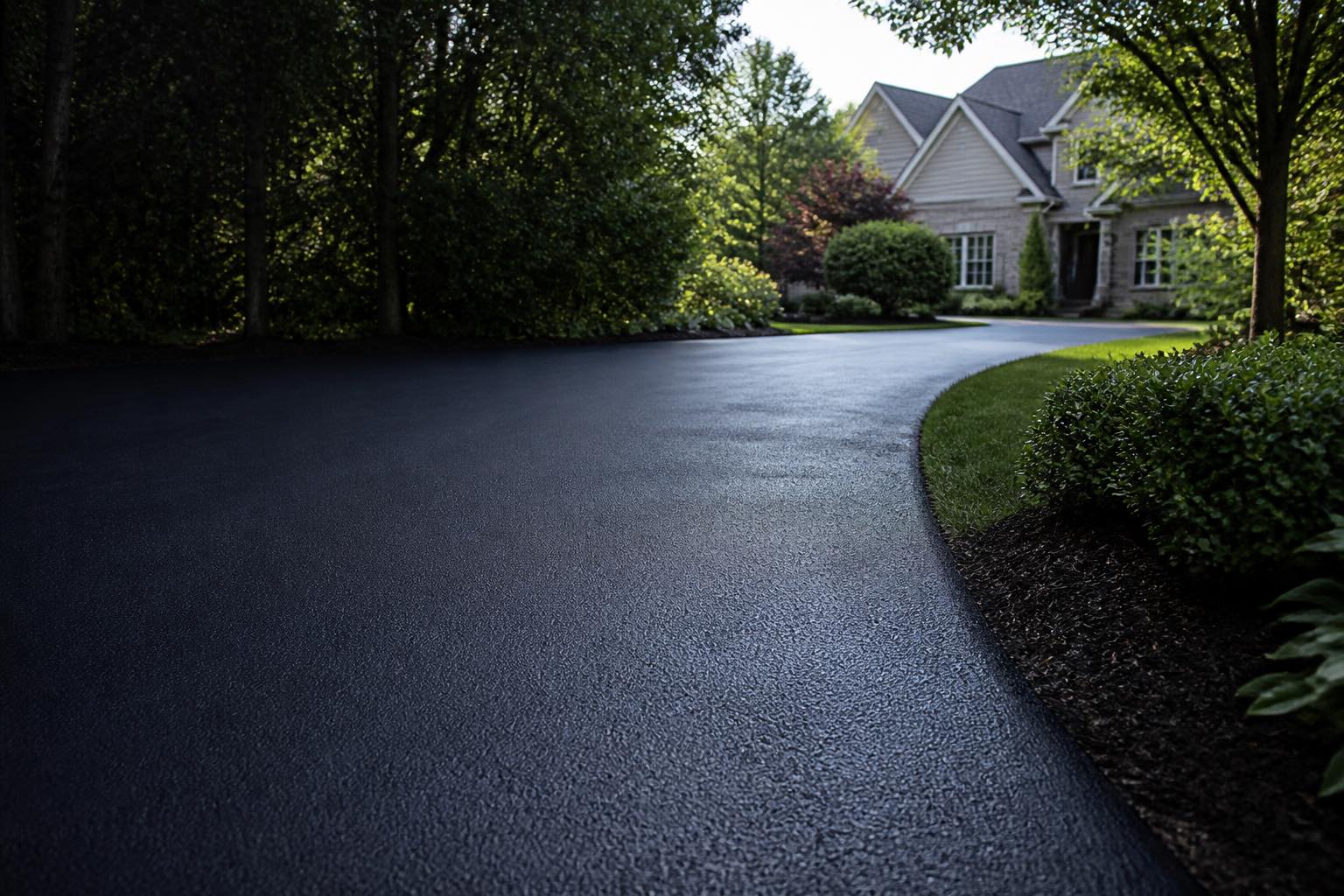
How should a Jamestown homeowner protect adjoining materials?
Photograph garage aprons, pavers, brick or stone edges, concrete walks, curbs, walls, fences, drainage grates, and planted borders before work. Decide whether the coating ends at a control joint, pavement edge, shared-property line, or public right-of-way. Masking, hand edging, spray shields, and a wind limit belong in the method when overspray would be difficult to remove.
Do not treat visual age as pavement diagnosis. A newer asphalt drive at an older-looking home can be too fresh to seal, while a recently coated surface can need no work. Record paving age and prior sealer if known, then inspect oxidation, cracks, patches, drainage, softness, and aggregate loss. The decision follows condition, not neighborhood character.
What is the Jamestown seasonal sequence?
Inspect cracks and drainage in early spring, clean after the heaviest pollen when practical, complete structural patches before coating, and use a dry April–October window that meets the product's temperature rule. In fall, review open cracks before winter temperatures repeatedly move around freezing. The month is a planning cue, not permission to ignore the forecast.
Many sealers require at least 50°F and no rain for 24 hours or more. Common vehicle closures run 24–48 hours and can reach 72 hours in shade or humidity. Plan where household vehicles, deliveries, caregivers, and guests will park. Blocking a narrow drive without an alternative can create more risk than waiting for a better date.
How should shared or small-site access be handled?
Confirm ownership and permission for any shared asphalt before measurement. Mark which branch, apron, or parking pad belongs in the scope, who moves vehicles, and how mail, waste pickup, service calls, and emergency access continue. A crew should not coat across a boundary because the pavement appears continuous.
For small commercial or community properties, phase entrances or preserve a pedestrian route when possible. Accessible parking and access aisles cannot simply disappear during restriping; verify the layout and temporary plan. Use cones and signs that remain visible at night, and name who can reopen the area after product cure and a final check.
What do Jamestown sealing prices depend on?
National July 2026 residential sealing references commonly span about $0.20–$0.65 per square foot. A compact Jamestown driveway can still have a minimum mobilization charge, while careful hand edging, masking, crack work, or access adds labor. No verified local menu was found, so the provider's written quote is the price source for the property.
Compare measured area, cleaning, pollen and vegetation removal, crack footage, patch exclusions, product family, application method, coverage rate, coats, adjacent-surface protection, wind and rain rules, closure, cleanup, and payment. A quote that protects a stone border and treats 120 feet of cracks is not equivalent to a thin unmasked spray price.