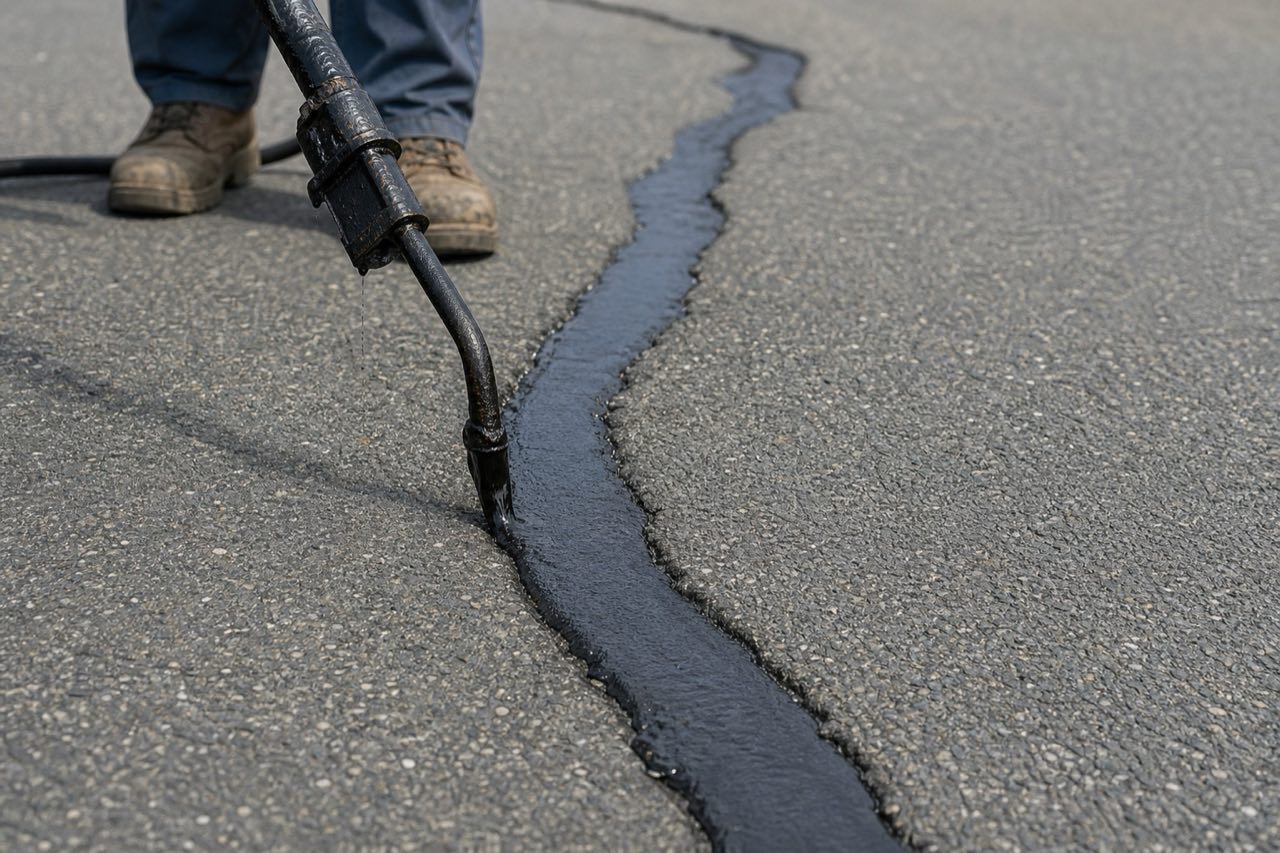
Which cracks are suitable for hot-pour treatment?
Longitudinal, transverse, construction-joint, and some reflection cracks with defined edges can be candidates. The crack needs enough opening to clean and accept material; very fine surface checks may not. Vegetation, loose fragments, old failed filler, and moisture reduce bond. Routing can create a consistent reservoir on selected projects, while blow-lance cleaning and direct fill may fit others.
Alligator cracking is different: many interconnected polygons usually indicate fatigue, insufficient support, moisture, or repeated load. Pouring black material over every line does not restore structural capacity. Wide edge breaks, depressions, heave, pumping, and cracks that immediately reopen after repair also deserve patch, drainage, base, or paving review before another filling cycle.
What should ASTM D6690 mean in the quote?
ASTM D6690 is a performance specification for hot-applied joint and crack sealants. Ask the vendor to name the material and applicable type, required heating range, pavement temperature limits, preparation method, reservoir or overband geometry, and traffic-opening rule. Overheating can damage rubberized material; underheating or applying to damp dusty walls can undermine adhesion.
The visible band should be controlled, not an uncontrolled puddle. A recessed fill, flush fill, or narrow overband can be appropriate depending on crack movement, traffic, future coating, and equipment. Ask how high spots will be avoided in pedestrian or turning areas and how fresh material will be protected from tires until it cools and sets.
What does crack filling cost in July 2026?
National guides publish roughly $0.50–$3.00 per linear foot, with professional direct pricing often cited around $0.90–$1.50 per foot. See the HomeGuide asphalt repair guide for one comparison source. Minimum mobilization, total footage, crack width, cleaning, routing, old-material removal, access, and traffic control can matter more than the headline unit price.
Ask bidders to measure or provide an allowance in linear feet and state how additional footage is approved. A driveway with 60 feet of clean transverse cracks is not comparable to a parking lot with 2,000 feet of dirty branching cracks across live traffic lanes. The vendor confirms the actual unit, minimum, and total after inspection.
What should happen from estimate through reopening?
The crew maps and measures eligible cracks, excludes failed areas, removes vegetation and loose material, dries and cleans the crack, heats the rubberized sealant within the product range, places a controlled fill or overband, blocks traffic until set, and records areas that still need patching. Sealcoat follows only after compatible crack material has cooled and the product sequence allows it.
Weather belongs in the work order. Many sealcoat products call for pavement and air temperatures of at least 50°F with temperatures staying above the minimum during cure, no rain for 24 hours or more, and warmer conditions for dependable drying. Crack and patch materials have their own rules. The vendor should confirm the named product, forecast threshold, postponement decision, and reopening time for the actual date.
What if the pavement reveals a different problem?
Adhesive failure pulls away from a crack wall; cohesive failure splits within the material; tracking transfers soft sealant to tires; and immediate reopening can reveal movement beyond the selected detail. Photograph the pattern and check surface temperature, moisture, preparation, material age, kettle control, geometry, and traffic timing before simply pouring more over the top.
Changes should be explicit. The crew should photograph the condition, explain why it falls outside the agreed scope, state the added quantity or alternate treatment, and obtain authorization before proceeding. You may choose the revision, defer that zone, or request another opinion. A surprise beneath dirt is possible; a blank permission slip for unlimited added work is not necessary.
How should you compare written proposals?
A useful quote states linear footage or allowance, crack width range, exclusions, cleaning and drying method, routing if any, ASTM D6690 material, heating control, fill geometry, overband width, traffic protection, compatibility with later sealcoat, unit price for extras, and treatment of failed areas. A bucket smeared over dusty cracks is not the same scope.
Confirm the actual provider before approval. North Carolina's general-contractor threshold under N.C.G.S. §87-1 is $40,000 for covered projects, so a typical residential sealing price does not prove or disprove qualification by itself. Property rules, scope, and other trades can create different requirements. Verify identity, insurance required by you or the property, references when available, payment terms, and responsibility for the proposed work.