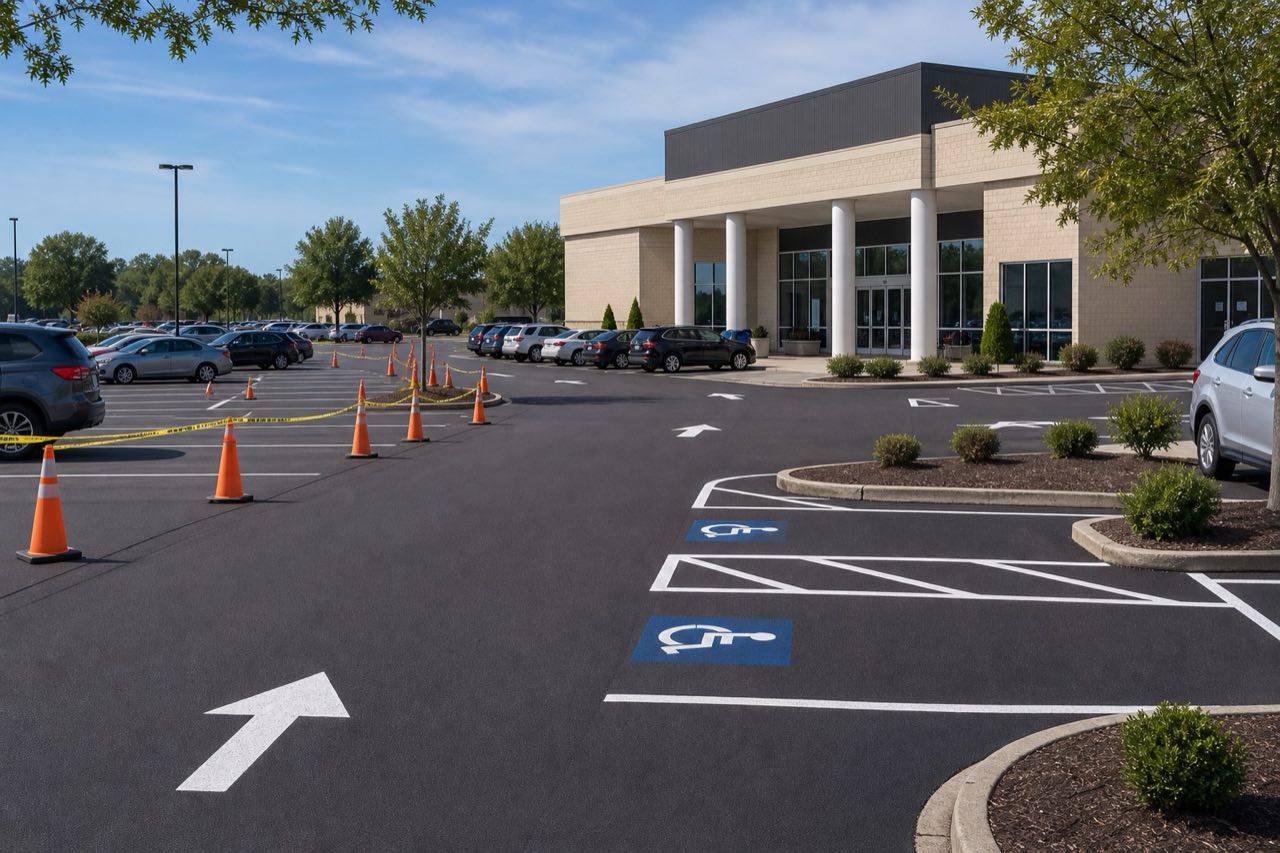
What belongs in a commercial condition inventory?
Map the lot by zone and mark open cracks, failed joints, potholes, rutting, settled utility cuts, broken edges, oil areas, drainage paths, dumpster approaches, loading lanes, turning areas, fire lanes, accessible stalls, access aisles, pedestrian routes, and current striping. Photograph and number the exceptions so bidders price the same pavement instead of making different guesses.
Separate preventative maintenance from capital repair. Sealcoat can protect a sound surface; it cannot strengthen a truck route that is rutting or keep a wet low spot from failing. Patch dimensions and depth, drainage work, crack quantities, and striping layout should be explicit alternates or line items. Otherwise the cheapest bidder can win by excluding the hardest areas silently.
When does ADA review enter a restriping project?
The U.S. Department of Justice says that when a business restripes a parking facility, it must provide accessible spaces under the 2010 ADA Standards. The ADA restriping brief explains counts, van spaces, access aisles, routes, signs, slopes, and location. Paint alone cannot correct a noncompliant slope or blocked accessible route.
Have the property owner or qualified designer confirm the current layout before old marks are copied. Count each parking facility separately, preserve the shortest accessible route to an entrance, and coordinate signs, wheel stops, curb ramps, and vertical clearance. The striping provider applies an approved layout; it should not be presented as issuing legal or accessibility certification.
What does commercial sealcoating cost in July 2026?
Published commercial references range roughly from $0.14–$0.50 per square foot for sealcoating, while combined seal-and-crack packages can reach about $0.60–$0.80 per square foot. Those are national or out-of-market comparison bands, not quoted Guilford County pricing. A large simple lot can have a lower unit cost than a small fragmented site with heavy hand work.
Measurement, mobilizations, degreasing, crack length, patch area, coats, material, traffic control, night or weekend work, number of phases, striping colors, symbol count, layout changes, and return trips determine the price. Ask for a base scope plus unit prices for additional crack filling, patching, or markings discovered after cleaning. The vendor confirms the written total.
What should happen from estimate through reopening?
Before work, the property team approves a zone map, dates, rain plan, towing policy, tenant notice, deliveries, waste pickup, emergency access, pedestrian route, and reopening authority. The crew closes one defined zone, repairs and cleans it, applies the specified product, restripes after cure, documents completion, and hands it back before the next zone closes.
Weather belongs in the work order. Many sealcoat products call for pavement and air temperatures of at least 50°F with temperatures staying above the minimum during cure, no rain for 24 hours or more, and warmer conditions for dependable drying. Crack and patch materials have their own rules. The vendor should confirm the named product, forecast threshold, postponement decision, and reopening time for the actual date.
What if the pavement reveals a different problem?
If a coating bidder finds rutting, pumping water, failed patches, moving joints, widespread alligator cracking, or unstable loading areas, require a repair branch before continuing. A recurring dumpster-lane failure may need deeper removal or drainage correction. Treating structural distress as a coating allowance distorts lifecycle cost and forces the same decision into next year's budget.
Changes should be explicit. The crew should photograph the condition, explain why it falls outside the agreed scope, state the added quantity or alternate treatment, and obtain authorization before proceeding. You may choose the revision, defer that zone, or request another opinion. A surprise beneath dirt is possible; a blank permission slip for unlimited added work is not necessary.
How should you compare written proposals?
Normalize bids by square footage, repair map, crack units, product and mix, application rate, coats, hand areas, mobilizations, phase map, traffic control, striping schedule, accessibility-layout responsibility, reopening criteria, weather cancellation, cleanup, and warranty language. Confirm who can authorize added work and who tells tenants that a zone is ready.
Confirm the actual provider before approval. North Carolina's general-contractor threshold under N.C.G.S. §87-1 is $40,000 for covered projects, so a typical residential sealing price does not prove or disprove qualification by itself. Property rules, scope, and other trades can create different requirements. Verify identity, insurance required by you or the property, references when available, payment terms, and responsibility for the proposed work.